
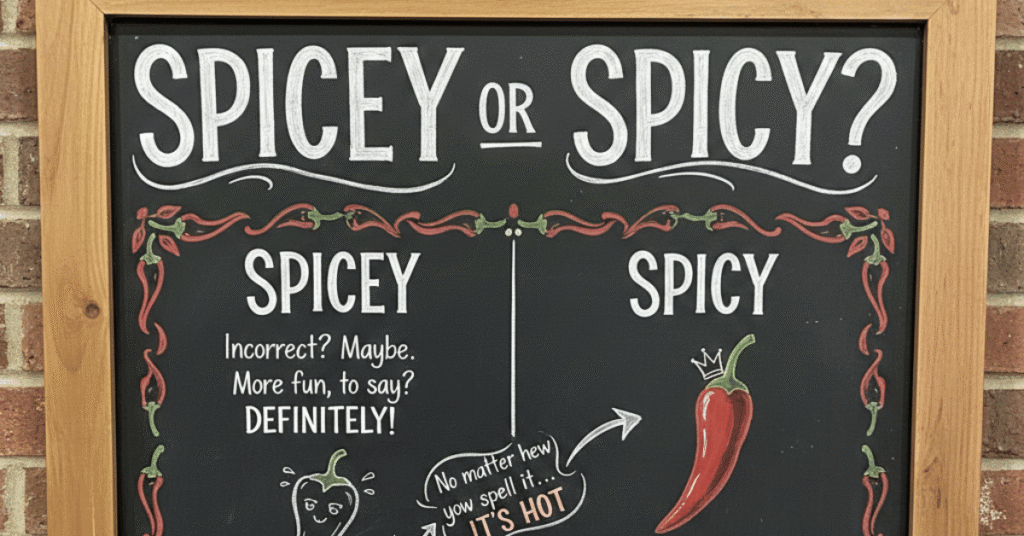

Spicey or spicy is one of those spelling questions that pops up when you’re writing about food, flavor, or even personality. You’ve probably seen both versions online—menus, captions, reviews—and wondered if maybe both are acceptable. Let’s clear up the confusion once and for all.
Quick Answer: Spicey or Spicy
Spicey or spicy has a simple, definitive answer:
-
Spicy — correct spelling
-
Spicey — incorrect spelling
Only spicy is recognized in standard English dictionaries. “Spicey” is a common misspelling, even though it looks logical at first glance.
Why “Spicy” Is the Correct Form
The word spicy comes from the noun spice, but English spelling rules drop the “e” before adding -y.
Easy Rule to Remember:
-
Spice + y = spicy
-
Silent “e” is removed
The same rule applies to:
-
Ice → icy
-
Smoke → smoky
-
Shine → shiny
If a word ends in -ce, the e usually disappears when adding -y.
Historical & Language Background
The word spice entered English from Old French espice, which traces back to Latin species, meaning “kind” or “sort.” Over time, English adapted spice into an adjective—spicy—to describe flavor, aroma, and intensity.
“Spicey” never developed as a legitimate spelling in English history, even though people still use it informally today.
Contextual Usage: Literal & Metaphorical
Literal (Food & Flavor)
Used to describe food with heat, seasoning, or strong flavor.
Examples:
-
“This curry is really spicy.”
-
“I love spicy chicken wings.”
Metaphorical Usage
Used to describe excitement, boldness, or drama.
Examples:
-
“The meeting got spicy after that comment.”
-
“She added a spicy twist to the story.”
Regional & Cultural Usage
| Spelling | US English | UK English | Global English |
| Spicy | Correct | Correct | Standard |
| Spicey | Incorrect | Incorrect | Nonstandard |
Across all English-speaking regions, spicy is the only accepted spelling.
Common Mistakes People Make
-
Adding an unnecessary “e” because of the base word “spice”
-
Assuming both spellings are informal alternatives
-
Copying misspellings from social media or menus
-
Using “spicey” in professional or academic writing
If you want to sound confident and polished, always choose spicy.
Real-Life Examples
Everyday Conversation
“This salsa is too spicy for me.”
Social Media
“Late-night cravings for spicy noodles ”
Food Reviews
“Perfect balance of spicy and savory flavors.”
Incorrect Usage
“The sauce is super spicey.”
Search Trends & Usage Data
| Term | Search Popularity | Correctness |
| Spicy | Very High | Correct |
| Spicey | Moderate | Incorrect |
Insight:
Many people searching “spicey” are actually double-checking their spelling—smart move.
Frequently Asked Questions (FAQs)
1. Is “spicey” ever correct?
No. It’s always considered a spelling error.
2. Why does “spicey” look right to so many people?
Because it closely follows the spelling of “spice,” but English drops the silent e.
3. Is “spicy” formal or informal?
It works in both casual and professional writing.
4. Does British English allow “spicey”?
No. British English uses spicy, just like American English.
5. Can “spicy” describe non-food things?
Yes. It’s commonly used metaphorically to describe drama, excitement, or bold ideas.
6. Are there similar tricky words?
Yes—icy, shiny, smoky, and tiny follow similar spelling rules.
Conclusion: Spicey or Spicy
Spicey or spicy may seem like a small spelling choice, but only one is correct. English quietly drops the extra “e,” leaving us with spicy every time. Once you know the rule, the confusion disappears for good.
Spicey or spicy—if you want your writing to sound sharp, flavorful, and correct, always go with spicy.