
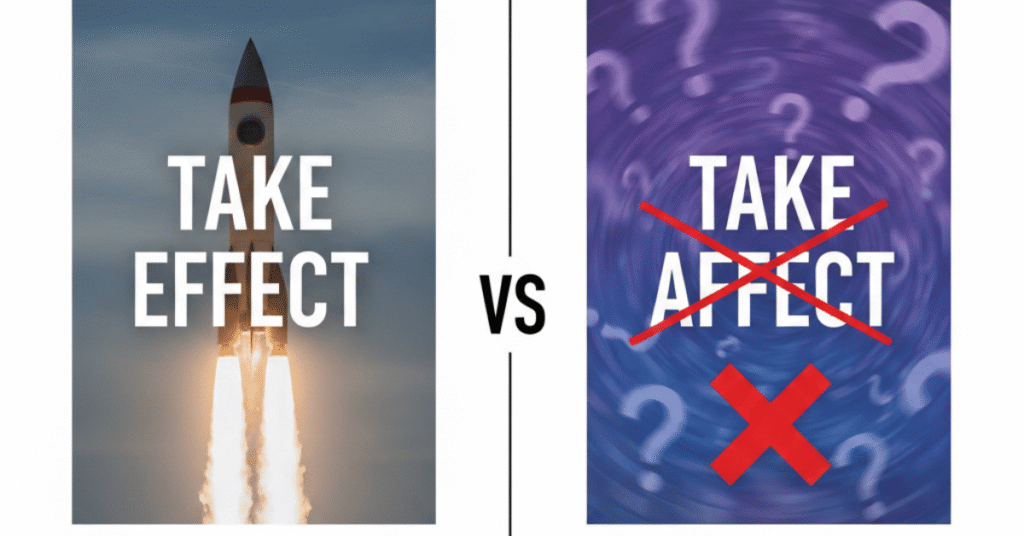

Take effect or take affect is a common question for writers, students, and professionals alike. Many people aren’t sure which version to use when describing laws, rules, medications, or any situation where something begins to produce results. Getting it wrong can make your writing look unpolished.
Let’s break it down so you’ll never be confused again.
Quick Answer: Take Effect or Take Affect
The correct phrase is:
-
Take effect — correct
-
Take affect — incorrect
Take effect is used when something starts to work, produce results, or come into force. Take affect is a common misspelling or mishearing but has no meaning in standard English.
Example:
“The new law will take effect on January 1st.”
What Does “Take Effect” Mean?
Take effect is a phrase that describes when something starts to work, whether physically, legally, or metaphorically.
Common uses:
-
Laws and regulations: “The new tax policy will take effect next month.”
-
Medications: “The painkiller should take effect within 30 minutes.”
-
Changes or events: “The new schedule will take effect on Monday.”
It’s about results and action, not emotions or influence.
Origin & Historical Background
The phrase take effect has been in use in English since at least the 16th century. It combines:
-
Take – to begin or assume
-
Effect – the result or outcome
It has always referred to the moment something starts to produce results, making it precise and formal enough for professional and legal writing.
Contextual Usage: Physical & Metaphorical
Physical Usage
“The anesthetic will take effect in a few minutes.”
Metaphorical / Legal Usage
“The new regulations will take effect immediately.”
Incorrect Usage
“The new law will take affect in January.”
This common error comes from confusing effect (result) with affect (verb meaning to influence).
Regional & Cultural Usage
| Phrase | US English | UK English | Global English |
| Take effect | Correct | Correct | Standard |
| Take affect | Incorrect | Incorrect | Non-standard |
No English-speaking region accepts take affect as correct.
Common Mistakes to Avoid
-
Confusing effect (noun) with affect (verb)
-
Using take affect in formal writing
-
Forgetting that take effect refers to results, not influence
Quick tip: If you’re talking about something starting to work, always use take effect.
Real-Life Examples
Professional / Legal
“The new company policies will take effect immediately.”
Medical
“The sedative will take effect within minutes.”
Social Media / Informal
“The change to the rules won’t take effect until next week.”
Incorrect Usage
“The new regulations will take affect next month.”
Search Trends & Usage Data
| Term | Search Volume | Accuracy |
| Take effect | High | Correct |
| Take affect | Moderate | Incorrect |
Insight:
Most searches for take affect come from spelling or pronunciation mistakes rather than intentional usage.
Frequently Asked Questions (FAQs)
1. Is “take affect” ever correct in English?
No. It’s always a misspelling of take effect.
2. Can I use “take effect” for emotions?
Yes, but only in the sense that an action or stimulus produces a result, e.g., “The speech took effect on the audience.”
3. What’s the difference between affect and effect?
-
Affect – verb meaning to influence
-
Effect – noun meaning result
4. Can “take effect” be used for policies?
Absolutely. It’s standard in legal, professional, and business contexts.
5. Is there a regional difference?
No, take effect is correct worldwide in English.
Conclusion: Take Effect or Take Affect
Take effect or take affect may sound confusing, but only one is correct in English. Take effect refers to something beginning to work or produce results, while take affect is a spelling mistake you want to avoid.