
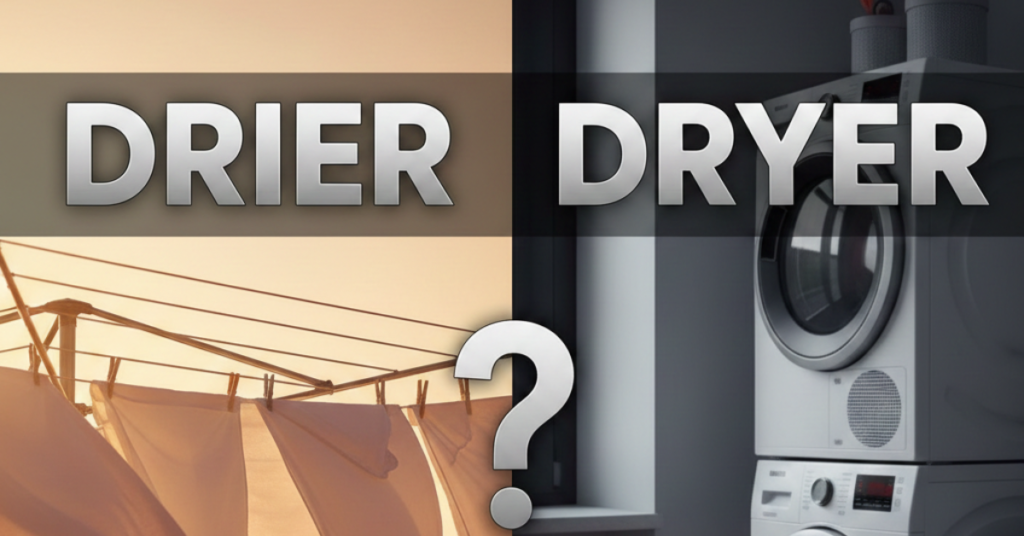

Drier or dryer is a common spelling question that trips up writers, students, and even native English speakers. You might ask yourself: “Is it drier or dryer when describing the weather?” or “Do I say dryer or drier for my laundry machine?” Let’s clear the confusion and make your writing precise.
Quick Answer: Drier or Dryer?
-
Drier → Correct when comparing dryness. Example: “Today is drier than yesterday.”
-
Dryer → Refers to a machine or device that dries things. Example: “I put my clothes in the dryer.”
Rule of Thumb: If it’s a comparative adjective, use drier. If it’s a noun for an appliance, use dryer.
Drier or Dryer Meaning
-
Drier: Comparative adjective of “dry.” Indicates more dryness.
-
“The desert is drier than the rainforest.”
-
“My hands feel drier after washing them.”
-
-
Dryer: Noun referring to a device or person that dries something.
-
“The hair dryer is plugged in.”
-
“I use a dryer for my laundry.”
-
Mnemonic: Adjective → drier; Appliance → dryer.
Origin and Historical Background
-
Drier comes from Old English drīe, evolving as a comparative form of dry.
-
Dryer emerged as a noun to describe machines and people who remove moisture, especially during the industrial revolution when laundry devices became common.
Fun Fact: The word “dryer” for appliances became widespread in the 20th century as electric dryers replaced traditional air drying.
Contextual Usage: Physical & Metaphorical
Physical Dryness
-
“The soil is drier this season.”
-
“My towel is drier than before.”
Appliances / Machines
-
“Place wet clothes in the dryer for 30 minutes.”
-
“The hand dryer in the restroom is broken.”
Metaphorical Use
-
“His humor was drier than usual today.” (Meaning more subtle or sarcastic)
-
“The lecture was drier than I expected.” (Meaning less engaging)
Regional Usage
| Term | Usage | Notes |
| Drier | US, UK, Global | Comparative adjective of “dry” |
| Dryer | US, UK, Global | Noun for machines, devices, or people |
| Drier weather | Common in meteorology | Correctly used in weather reports |
| Dryer machine | Household appliance | Widely recognized spelling |
Tip: In both American and British English, the distinction is the same.
Common Mistakes to Avoid
-
Writing dryer than today instead of drier than today
-
Using drier for a machine: “I put clothes in the drier”
-
Confusing the adjective with metaphorical humor: “His jokes are dryer” (Correct)
Pro Tip: If you can replace it with “more dry,” you should use drier.
Real-Life Examples
-
Weather:
-
“This month is drier than last month.”
-
“This month is dryer than last month.”
-
-
Laundry & Appliances:
-
“Put the wet sheets in the dryer.”
-
“Put the wet sheets in the drier.”
-
-
Humor / Style:
-
“Her comments were drier than ever.”
-
Data & Trends
| Keyword | Popularity | Notes |
| drier weather | High | Commonly searched by meteorology enthusiasts |
| dryer machine | High | Household appliance context |
| drier vs dryer | High | Frequently queried spelling difference |
| drier hands | Moderate | Personal care usage |
Observation: Most online searches clarify that drier is for comparison and dryer is for devices.
FAQs About Drier or Dryer
-
Is it drier or dryer for weather?
Use drier. “Today is drier than yesterday.” -
Can I say dryer for my laundry?
Yes, dryer is correct for machines. -
Is drier or dryer British or American English?
Both spellings follow the same rule; usage is identical in UK and US. -
Can drier be used metaphorically?
Yes. “His humor is drier than mine.” -
Is it wrong to say drier machine?
Yes, always use dryer machine. -
Any mnemonic to remember?
Adjective → drier
Noun (machine/person) → dryer -
Does dryer mean more dry in some contexts?
No, only drier is used for comparison.
Conclusion: Drier or Dryer
In summary, drier or dryer depends entirely on context:
-
Drier → Use for comparisons or describing dryness
-
Dryer → Use for machines, devices, or people who dry things
Memorable takeaway: When in doubt, remember: adjective = drier, appliance = dryer. That’s your quick guide for all writing and everyday usage!