
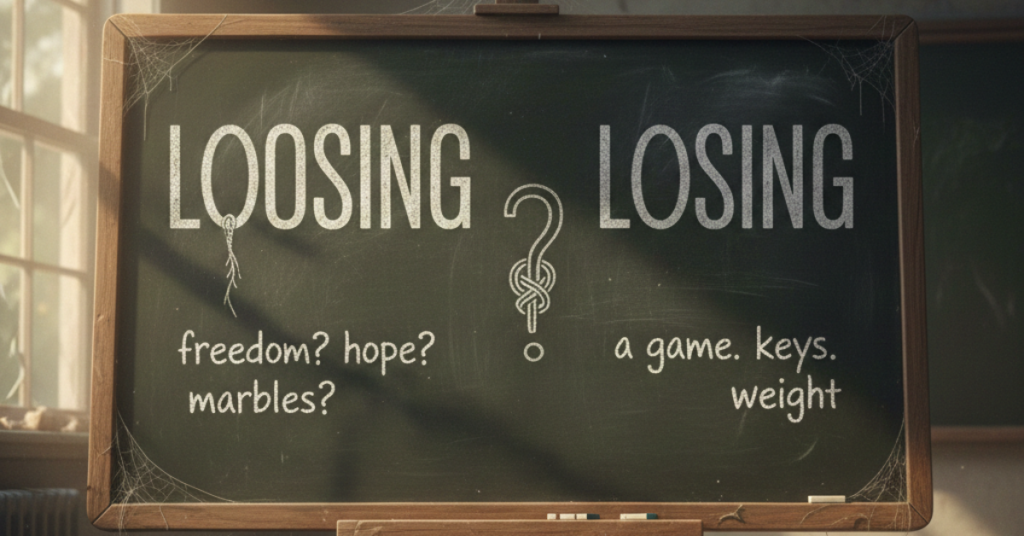

Loosing or losing is a common spelling and grammar confusion that many people search for online. Whether you’re writing an essay, posting on social media, or texting a friend, using the wrong word can change your sentence meaning entirely. It’s easy to type loosing because it seems logical, but is it really correct? Let’s clear this up once and for all.
Quick Answer: Loosing or Losing
-
Losing → Correct when you mean to fail to win or to misplace something
-
Loosing → Only correct in very specific contexts (like loosing a rope or releasing something)
Tip: Most of the time, when people mean they didn’t win or can’t find something, the right word is losing.
Why the Confusion Happens
-
Both words sound almost identical when spoken
-
English learners often confuse losing with loosing because of the extra “o”
-
Typing quickly or autocorrect can introduce the mistake
-
Loosing exists, but in different contexts related to release or slackening
Historical Background
-
Losing comes from Old English losian, meaning “to perish or be lost”
-
Loosing comes from Old English losian in the sense of “setting free or releasing”
-
Both share roots but evolved with different grammatical usage
So, historically, both are real words—but only losing is appropriate in everyday situations of not winning or misplacing.
Contextual Usage: Physical & Metaphorical
Losing (Most Common Usage)
-
Definition: Failing to keep, win, or maintain something
-
Examples:
-
“I’m losing my keys again.”
-
“They are losing the match by two goals.”
-
“She’s losing hope after repeated failures.”
-
Loosing (Less Common, Specific Usage)
-
Definition: Letting something loose, releasing, or slackening
-
Examples:
-
“Loosing the ropes helped free the boat.”
-
“He is loosing the reins of control.”
-
Notice: Using loosing to mean misplacing or failing is incorrect.
Regional & Cultural Usage
| Word | Usage Region | Notes |
| Losing | US, UK, Global | Standard spelling for misplacement or defeat |
| Loosing | US, UK, Global | Correct only for release or slackening; rarely used in daily writing |
Common Mistakes to Avoid
-
“I’m loosing my phone” → Incorrect
-
“They are loosing the game” → Incorrect
-
Using loosing in casual texting without knowing the proper meaning
Always ask yourself: Am I talking about failing, missing, or misplacing something? If yes → losing.
Real-Life Examples
Social Media
“I can’t believe I’m losing another level in this game ”
Workplace
“We are losing valuable clients due to slow responses.”
Conversation
“Stop loosing time arguing and focus on the solution.”
Corrected: “Stop losing time arguing and focus on the solution.”
Sports
“The team is losing by three points at halftime.”
Usage Trends
| Spelling | Popularity | Correctness |
| Losing | Very High | ✅ Correct |
| Loosing | Moderate | ⚠️ Only context-specific |
Most search queries for loosing or losing are from students, writers, and ESL learners.
Frequently Asked Questions (FAQs)
1. Is “loosing” ever correct?
Yes, but only when referring to releasing, loosening, or letting go.
2. Can “losing” be used for emotions?
Yes—e.g., “She is losing hope.”
3. Why do people type “loosing” by mistake?
Phonetic spelling and the association with “loose” cause the error.
4. Does British English prefer one spelling over the other?
No, both follow the same rules globally.
5. Is “losing” only for games?
No, it applies to misplacing items, failing, or missing opportunities.
6. How can I remember the difference?
Think: lose → losing (fail or misplace), loose → loosing (release something).
7. Is “loosing” commonly seen online?
Yes, but mostly in informal texts, and often incorrectly.
Final Thoughts: Loosing or Losing
Loosing or losing is a common trap, but understanding the difference keeps your writing accurate and professional. Most of the time, if you’re talking about failing or misplacing something, the word you need is losing.
Memorable takeaway:
Loosing or losing—if it’s about failure, misplacement, or defeat, always go with losing. Save loosing for situations where something is being released or let go.