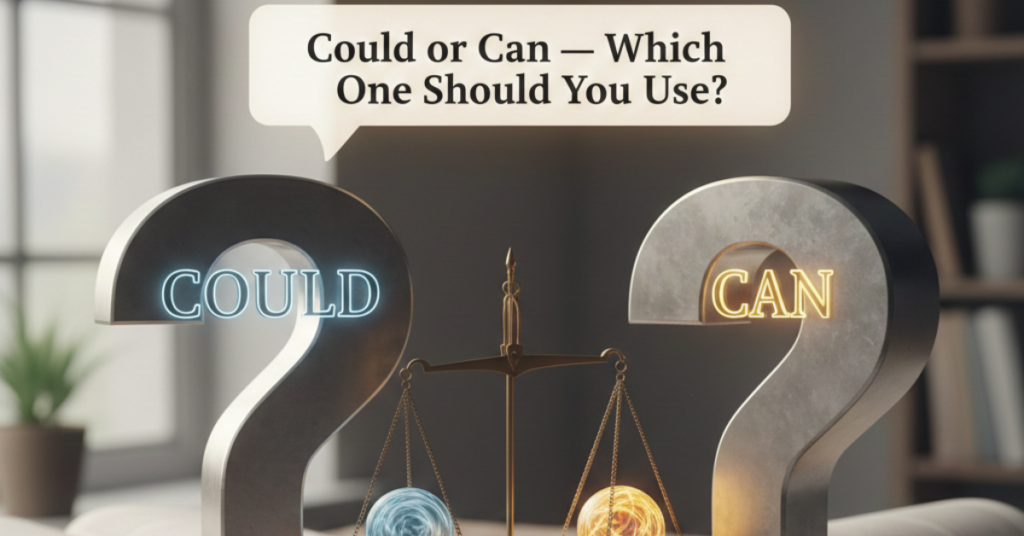

Have you ever paused mid-sentence wondering, “Should I say could or can here?” If so, you’re not alone. Choosing between could or can might seem small, but it affects how clear and confident your English sounds. In this article, we’ll unpack the difference, show real-world examples, and help you use these words like a native speaker.
Whether you’re writing an email, speaking in a meeting, or texting a friend with “could or can you please,” this guide has you covered.
What’s the Difference Between Could or Can?
At first glance, could and can might look like simple alternatives. But they each serve unique roles in English.
Can: Present Ability or Possibility
Use can when talking about something that is true now.
-
I can swim.
-
You can call me later.
-
Can you help me with this?
Here, can expresses ability, permission, or possibility in the present tense.
Could: Past Ability, Polite Requests, or Possibility
Use could when referring to:
-
Past actions (when can isn’t correct).
-
Polite requests.
-
Hypothetical situations.
Examples:
-
When I was younger, I could run fast.
-
Could you please pass the salt?
-
It could rain later today.
When to Say “Could or Can You Please”
The phrase could or can you please often shows up in polite requests. Let’s see how to choose:
-
Use Can you please for straightforward, friendly requests.
-
Can you please send the document?
-
-
Use Could you please when you want to be extra polite or formal.
-
Could you please review my report?
-
Both are correct—but could you please sounds more courteous.
Quick Rules: Could vs. Can
Here’s an easy snapshot to remember:
| Situation | Use |
| Present ability | Can |
| Past ability | Could |
| Polite request | Could (better) |
| Permission right now | Can |
| Hypothetical / uncertain | Could |
Examples in Everyday English
Let’s look at real-life contexts:
Texting a friend:
-
Can you please pick up milk on your way home?
In a job email:
-
Could you please send the revised schedule by 3 PM?
Talking about skills:
-
I can solve basic math problems.
-
When I was a kid, I could play piano.
Common Mistakes and How to Avoid Them
Here are some traps learners fall into — with corrections:
-
Could I go now? (when asking permission now)
Can I go now? -
Can you help me be polite?
Could you help me, please?
The key is context — think about when and how the action happens.
Could or Can: Summary You Can Use Today
-
Can = present ability/permission
-
Could = past ability, polite requests, or possibilities
-
Both coold and can you please work, but could is more polite
By understanding these subtle differences, your English will sound more natural and confident. Next time you’re writing or speaking, trust your instinct — and remember this guide.
FAQs About Could or Can
1. What’s the main difference between “could or can”?
Can refers to present ability or permission. Could refers to past ability or polite requests.
2. Can I use “could you please” in formal writing?
Yes — it’s actually preferred when you want to sound polite and respectful.
3. Is “could” always more polite than “can”?
Generally, yes. But in casual settings, can is perfectly fine.
4. Can “could” be used for future possibilities?
Yes — could can express possibility (e.g., It could rain later.)
5. Should I say “can you please” in emails?
It’s okay for informal emails. For professional tone, could you please works better.