
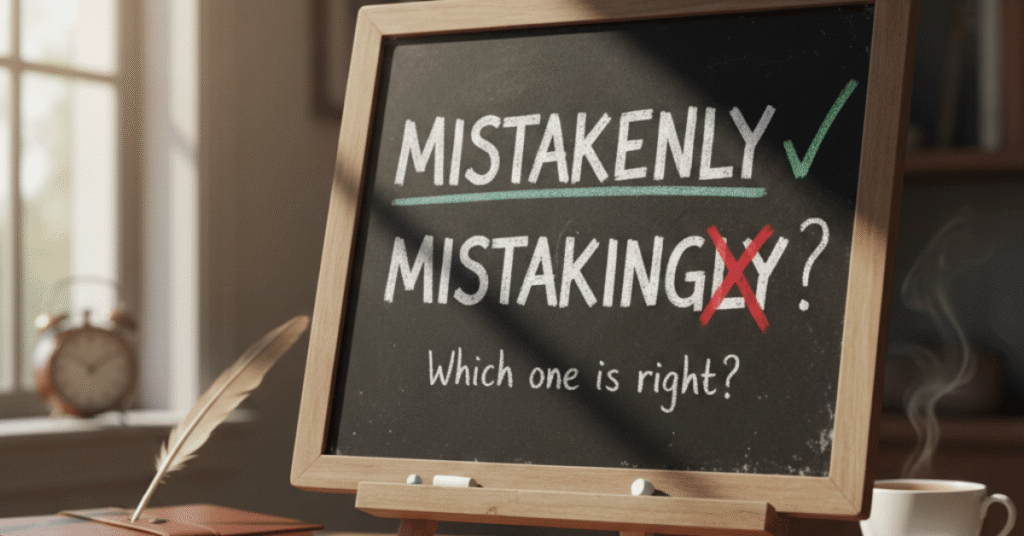

Mistakingly or mistakenly is a question many people search for right after rereading a sentence and feeling that something sounds off. You may have seen both forms in writing, heard them in conversation, or even used one confidently—only to wonder later if it was correct. You’re not alone. This is a classic English usage puzzle that trips up students, professionals, and native speakers alike.
Let’s clear it up once and for all.
Quick Answer: Mistakingly or Mistakenly?
Mistakingly or mistakenly has a clear winner in standard English:
-
Mistakenly is the correct and widely accepted adverb.
-
Mistakingly exists but is considered nonstandard, awkward, and rarely recommended.
If you want your writing to sound natural, polished, and correct, use “mistakenly.”
What Does “Mistakenly” Mean?
Mistakenly means by mistake, incorrectly, or as a result of an error. It describes how an action was done.
Example:
I mistakenly sent the email to the wrong person.
It explains that the action wasn’t intentional—it happened because of an error.
Why Does “Mistakingly” Sound Wrong?
The confusion comes from how adverbs are formed in English.
-
Mistakenly comes from the adjective mistaken
-
Mistakingly comes from the verb mistaking
Grammatically, mistakingly can be formed—but English usage doesn’t favor it. Over time, mistakenly became the standard, while mistakingly faded into obscurity.
Most dictionaries, editors, and style guides either:
-
Label mistakingly as rare or awkward
-
Or advise avoiding it altogether
How to Use “Mistakenly” in Context
Literal / Everyday Use
She mistakenly believed the meeting was today.
Professional or Academic Writing
The data was mistakenly interpreted in the initial report.
Metaphorical or Abstract Use
He was mistakenly confident about the outcome.
In all these cases, mistakenly sounds natural and fluent.
Regional Usage: US vs UK
Good news—this one is consistent worldwide.
| Region | Preferred Form |
| United States | Mistakenly |
| United Kingdom | Mistakenly |
| Canada | Mistakenly |
| Australia | Mistakenly |
Across global English, mistakenly is the standard choice.
Common Mistakes to Avoid
Here’s where writers often slip up:
-
Using mistakingly in formal writing
-
Assuming both forms are equally acceptable
-
Overthinking the grammar and avoiding the word altogether
Incorrect:
I mistakingly assumed the store was open.
Correct:
I mistakenly assumed the store was open.
Real-Life Examples
Conversation
Sorry, I mistakenly took your jacket.
Social Media
I mistakenly posted the draft instead of the final version
Workplace or Training
The form was mistakenly filled out with outdated information.
Usage Trends & Language Preferences
| Word | Frequency in Modern English | Professional Acceptance |
| Mistakenly | Very High | Strong |
| Mistakingly | Very Low | Weak |
| By mistake | Very High | Strong |
| Incorrectly | High | Strong |
Language data clearly shows mistakenly dominating both spoken and written English.
FAQs About Mistakingly or Mistakenly
1. Is “mistakingly” grammatically incorrect?
Not technically incorrect, but it’s nonstandard and discouraged.
2. Why does “mistakenly” sound more natural?
Because it’s been historically favored and widely used for centuries.
3. Can I use “by mistake” instead?
Absolutely. It’s often clearer and more conversational.
4. Do dictionaries include “mistakingly”?
Some do, but usually label it as rare or uncommon.
5. Is mistakenly formal or informal?
It works well in both formal and informal contexts.
6. Should I ever use mistakingly?
Only if you’re deliberately experimenting with language—but not in standard writing.
Final Thoughts: Mistakingly or Mistakenly—Settled for Good
Mistakingly or mistakenly doesn’t need to cause hesitation anymore. While mistakingly technically exists, “mistakenly” is the correct, natural, and professional choice in modern English.
Memorable takeaway:
If you want your writing to sound confident and correct, skip mistakingly and go straight to mistakenly.
Mistakingly or mistakenly becomes an easy choice once you remember this: English favors what sounds natural—and mistakenly wins every time.