
To bad or too bad is one of the most commonly searched grammar questions online — and honestly, it’s easy to see why. The two phrases sound exactly the same when spoken. So when you’re typing fast, especially on social media or in texts, it’s easy to hesitate.
You might find yourself thinking:
-
Is it to bad or too bad?
-
Is “to bad” ever correct?
-
Why does English make this so confusing?
Let’s clear it up once and for all.
Quick Answer: Is It To Bad or Too Bad?
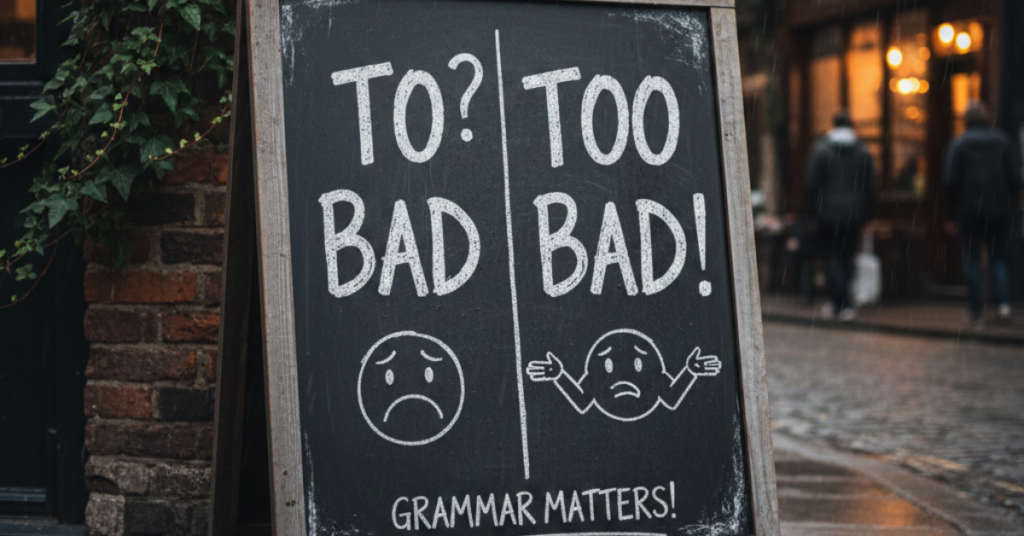
The correct phrase is “too bad.”
“Too bad” means unfortunate, sadly, or that’s a shame.
“To bad” is grammatically incorrect in almost all cases.
Simple Rule:
-
Too = also / excessively / unfortunately
-
To = direction or purpose
If you’re expressing disappointment, sympathy, or mild sarcasm, you want:
“Too bad.”
What Does “Too Bad” Mean?
“Too bad” is an expression used to show:
-
Sympathy → Too bad you missed the party.
-
Disappointment → Too bad it’s raining.
-
Mild sarcasm → Too bad, I already left.
It’s conversational, casual, and widely used in spoken English.
A Quick Look at the Origin
The word “too” comes from Old English tō, which originally meant “in addition” or “excessively.” Over time, it evolved into its modern meanings:
-
Also
-
More than necessary
-
Regrettably (in expressions like “too bad”)
The phrase “too bad” became common in conversational English in the 19th century as a shortened way of saying:
“It is too bad that…”
Eventually, we dropped the rest of the sentence and kept the phrase.
Why People Confuse “To Bad or Too Bad”
English is tricky because:
-
“To” and “too” sound identical.
-
We type quickly.
-
Autocorrect doesn’t always catch it.
Here’s a simple comparison:
| Word | Meaning | Example |
| To | Direction / Purpose | I’m going to school. |
| Too | Also / Excessively | It’s too hot. |
| Too bad | Expression of regret | Too bad you can’t come. |
If the phrase expresses regret, it must be too bad.
US vs UK Usage
Good news: there’s no difference here.
-
United States: “Too bad” is standard.
-
United Kingdom: Same usage.
-
Globally: English speakers everywhere use “too bad.”
Spelling and meaning remain consistent worldwide.
Contextual Usage: When to Say “Too Bad”
Sympathy
“Too bad you didn’t get the job.”
Tone: Gentle, understanding.
Casual Disappointment
“Too bad the game got canceled.”
Tone: Neutral, factual.
Sarcastic or Dismissive
“Too bad. I’m not changing my mind.”
Tone: Slightly firm or indifferent.
Tone matters more than the words themselves.
Real-Life Examples (Text & Social Media)
You’ll see “too bad” everywhere:
Text Message
Friend: “I can’t make it tonight.”
You: “Aw, too bad!”
Instagram Comment
“Too bad I missed this event!”
Workplace Email (Less Common, But Possible)
“It’s too bad the deadline was moved up.”
In professional settings, you might use:
-
“That’s unfortunate.”
-
“It’s regrettable.”
But in everyday conversation, “too bad” is perfectly natural.
Common Mistakes With “To Bad or Too Bad”
Writing “to bad”
Incorrect:
“To bad you missed it.”
Correct:
“Too bad you missed it.”
Overusing It
Saying “too bad” in serious situations can sound insensitive.
For example:
“My dog passed away.”
“Too bad.”
That sounds cold. In emotional contexts, choose:
-
“I’m so sorry.”
-
“That’s heartbreaking.”
Confusing With “Too” in Other Contexts
“Too” can mean “excessively”:
It’s too cold.
That’s different from:
Too bad.
Same spelling, different function.
Why This Grammar Question Is So Popular
Search trends show that homophones (words that sound the same) are among the most searched grammar topics.
Here’s why:
| Reason | Explanation |
| Sound Confusion | “To” and “too” sound identical |
| Fast Typing | Mistakes happen in texts |
| ESL Learners | Common challenge for English learners |
| Social Media | Public writing increases awareness |
People want clarity — and clarity builds confidence.
Quick Memory Trick
Here’s an easy trick to remember:
If you can replace it with “very” or “also”, use too.
Example:
It’s too hot. (Very hot)
Now try:
It’s too bad.
You can’t replace it with “to” in any way that makes sense.
That’s your clue.
FAQ: To Bad or Too Bad Grammar
1. Is it to bad or too bad?
The correct phrase is too bad.
2. Is “to bad” ever correct?
Almost never. “To” requires a verb or direction after it, like “to go” or “to school.”
3. What does “too bad” mean?
It expresses regret, disappointment, or mild sympathy.
4. Can “too bad” be rude?
It can sound dismissive depending on tone and context.
5. Is “too bad” formal?
It’s casual. In formal writing, use “unfortunate” or “regrettable.”
6. Why do people confuse to and too?
Because they sound identical in speech.
7. How can I avoid this mistake?
Remember: Too has an extra “o” — just like it means extra.
Final Thoughts
To bad or too bad may seem like a small grammar question, but getting it right makes your writing clearer and more professional. English homophones can trip anyone up — even native speakers.
Here’s the simple truth:
If you’re expressing regret or disappointment, always write too bad.
When in doubt, remember this:
Too has an extra “o” because it means something extra.
Mastering small details like this builds stronger communication skills — and confident writers stand out.