
If you’ve ever paused while writing a sentence like “Who/Whom should I ask?” you’re not alone. Many English speakers struggle with the difference between who vs whom. Understanding this subtle but important rule can make your writing and speaking sound polished and professional.
In this guide, we’ll break down who vs whom, show clear examples, provide an easy trick, and even include a small quiz so you can practice confidently.
Quick Answer: Who vs Whom
-
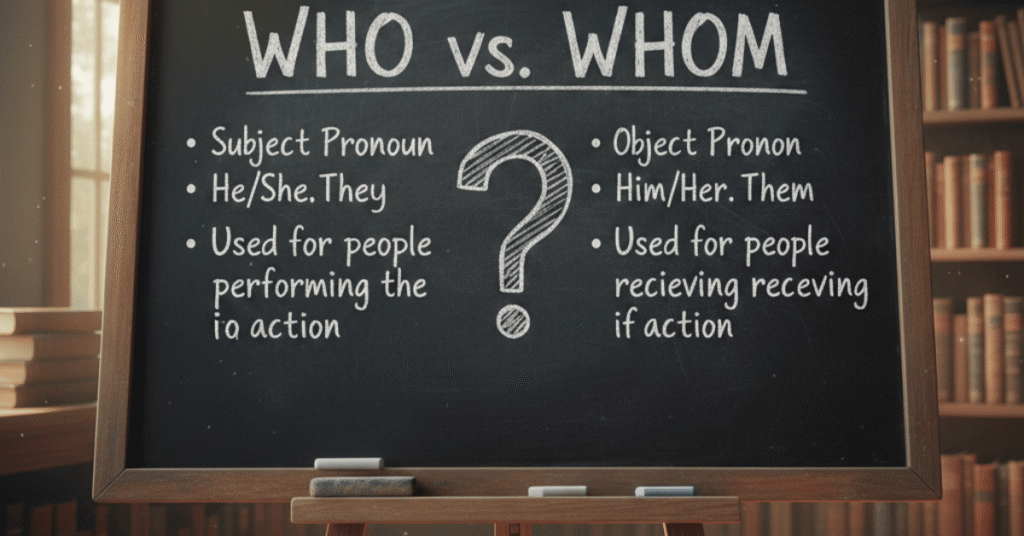
Who — used as the subject of a sentence or clause.
-
Example: “Who is coming to the party?”
-
-
Whom — used as the object of a verb or preposition.
-
Example: “To whom should I give this letter?”
-
Tip: If you can replace the word with he/she/they, use who. If you can replace it with him/her/them, use whom.
Historical Background
The distinction between who and whom comes from Old English grammar. Who evolved from hwa, meaning “what person,” while whom comes from hwam, used as the object of a verb or preposition.
Over time, informal English has blurred the line, and many native speakers now use who in situations where traditional grammar would prefer whom. However, knowing the difference is essential for formal writing, professional communication, and passing grammar quizzes.
Contextual Usage: Physical & Metaphorical
Who (Subject)
-
Performs the action in the sentence.
-
Physical example: “Who opened the door?”
-
Metaphorical: “Who inspires you most?”
Whom (Object)
-
Receives the action or is affected by it.
-
Physical example: “Whom did you call?”
-
Metaphorical: “To whom do we owe our gratitude?”
Common Mistakes to Avoid
-
“Whom is going to the store?” (Incorrect — should be Who)
-
“Who did you give the book to?” (Technically correct in informal English, but Whom is preferred in formal writing: “To whom did you give the book?”)
Correct usage:
-
“Who wants to join the team?”
-
“Whom are you inviting to the dinner?”
Easy Trick to Remember Who vs Whom
Use the he/him rule:
| Replacement | Use |
| He / She / They | Who (subject) |
| Him / Her / Them | Whom (object) |
Example:
-
“Who/Whom is calling?” → “He is calling” → Who
-
“You met who/whom yesterday?” → “I met him” → Whom
Real-Life Examples
Social Media
-
“Who wants to join our challenge?”
-
“To whom should I send the DM?”
Professional / Formal Writing
-
“Who will oversee the project?”
-
“The manager, whom we respect, provided guidance.”
Everyday Conversation
-
“Who left this note on my desk?”
-
“With whom did you go shopping?”
Data and Trends
| Term | Popularity | Correct Context | Notes |
| Who | Very High | Subject of clause or sentence | Used widely, even informally as object |
| Whom | Moderate | Object of verb or preposition | More formal; less used in casual speech |
Data from linguistic surveys and Google Trends show that whom is declining in casual usage, but remains important in formal contexts.
Who vs Whom Quiz
Choose the correct word:
-
______ is responsible for this project?
-
To ______ did you give the keys?
-
______ wants ice cream?
-
The teacher, ______ we admire, spoke today.
-
With ______ are you going to the event?
Answers:
-
Who
-
Whom
-
Who
-
Whom
-
Whom
FAQs About Who vs Whom
-
Can I use who instead of whom in casual speech?
-
Yes, in informal contexts, many native speakers do. Formal writing prefers whom.
-
-
Is there a trick to always know?
-
Yes, the he/him rule is the easiest way to remember.
-
-
Does whom sound old-fashioned?
-
Somewhat, but it is still correct in professional and formal writing.
-
-
Can who start a sentence?
-
Absolutely. Example: “Who will take the lead?”
-
-
What about after prepositions?
-
Always use whom after prepositions: “To whom it may concern.”
-
-
Are there exceptions to these rules?
-
Very few, mostly idiomatic expressions. Stick with who for subjects and whom for objects.
-
Final Thoughts: Mastering Who vs Whom
Understanding who vs whom may seem tricky, but it’s easier than it looks. Remember: Who = subject, Whom = object. Use the he/him rule to check, practice with examples, and you’ll never hesitate again.
Takeaway: Confidently use who vs whom in every sentence and elevate both your writing and speaking.